
AI-First Product Delivery
GenAI-Driven Product Excellence — The New Frontier of Product Delivery
Development velocity
Repetitive admin cut
Faster Jira task creation
New member productivity
The XR project was a strategic imperative in enterprise digital transformation, moving the product delivery engine from translation-heavy, manual processes to an AI-augmented lifecycle. This fundamental rewiring focused on optimizing delivery velocity and system interoperability. By transitioning from fragmented documentation to an integrated GenAI-enhanced workflow, the project mitigated the translation tax that plagues large-scale efforts. The core mission was to collapse the product delivery cycle from two weeks to three days by using GenAI to convert raw ideation artifacts into high-integrity PRDs, epics, and test-ready technical specifications—turning the PM-to-Dev lifecycle into a high-fidelity pipeline for innovation.
Discovery // Identifying the Translation Tax in Traditional Workflows
Meaningful digital transformation begins with a clinical evaluation of the translation tax—the cognitive load and administrative overhead to move a concept from ideation to execution. In traditional workflows, knowledge is lost in the dead zones between tools, causing a degradation of intent and forcing developers to build from incomplete artifacts, resulting in significant downstream churn.
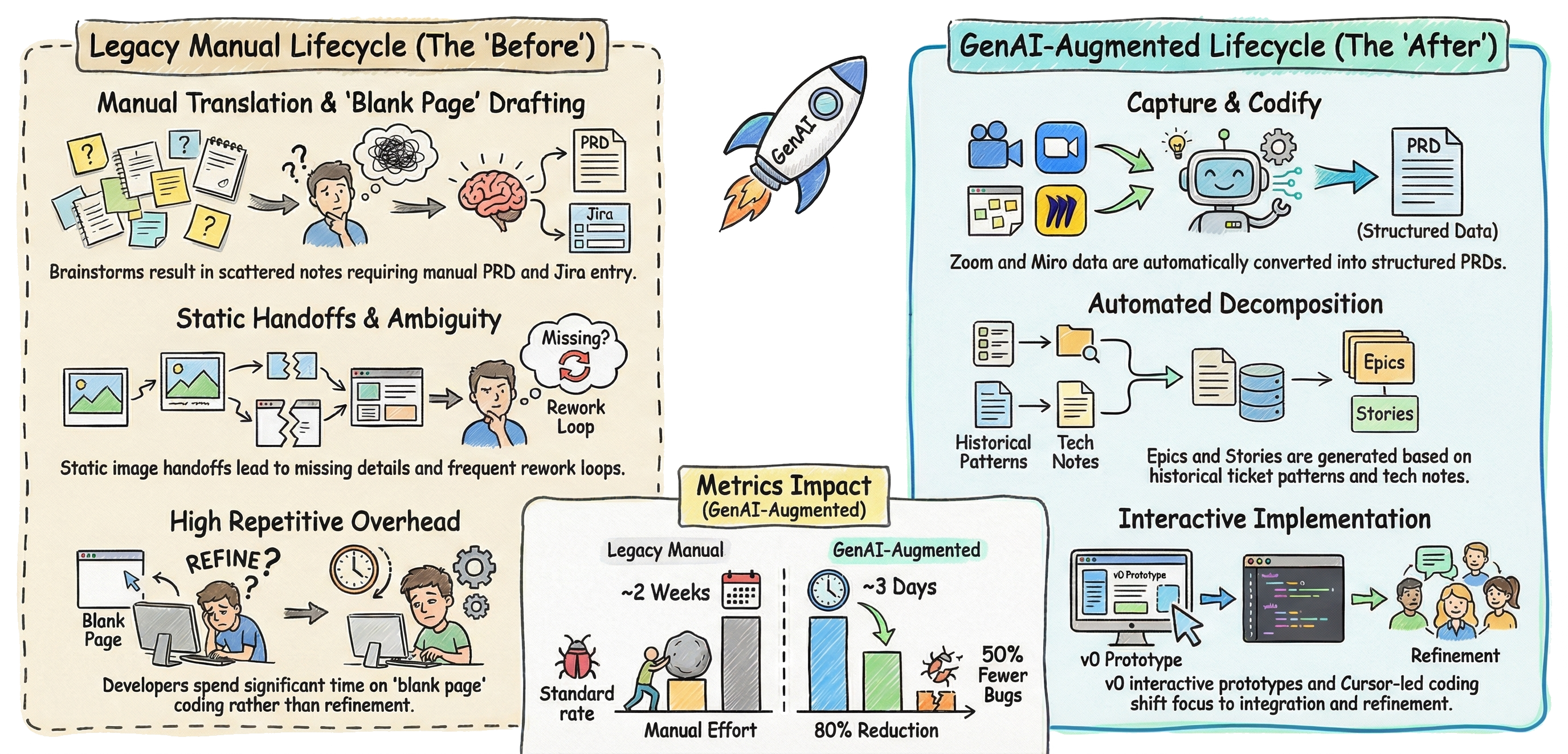
Our analysis of the legacy XR workflow identified critical pain points from technical debt and scattered context. Critical ideation context (e.g., Zoom recordings, Miro boards) was fragmented in non-searchable notes, causing institutional knowledge loss. Manually translating these concepts into technical requirements drove administrative overhead and slower time-to-market. Fragmented requirements, blank-page coding delays, and AI agents unable to leverage historical data further slowed progress.
A core issue was inconsistent Product Requirements Documents (PRDs) and missing nuance. Manual PRD authoring was slow, prone to individual bias, and lacked the standardization required for complex integration, introducing gaps discovered late in the sprint. Downstream churn consistently followed as rework loops, implementation errors, and persistent communication to clarify requirements.
Finally, static handoffs created drafting overhead. Extensive manual work was required to decompose PRDs into Jira stories. These traditional, static design handoffs created implementation blind spots, forcing developers to make assumptions. This invariably led to rework loops and stakeholder misalignment on UI/UX behavior, resulting in front-end ambiguity and high bug counts.
In the Weeds // The Mechanics of the GenAI-Augmented Lifecycle
The core strategic shift in the XR project was the transition from Static Documentation to Structured Fuel. We re-architected the workflow to prioritize the seamless flow of structured data across five or more integrated AI systems. That made the PM-to-Dev handoff an exercise in refinement rather than laborious translation—eliminating blank-page coding and freeing the team to focus on high-value integration and system architecture.
The five-step augmented process:
(1) Understanding needs: Cursor was used to translate complex, messy business requirements from transcripts into clear, actionable project plans.
(2) Planning: AI agents designed the complete system structure, proactively identifying dependencies and architectural building blocks before a single line of code was initiated.
(3) Building: leveraging Cursor’s proactive “vibe coding” capabilities, the AI generated the majority of code blocks and established the underlying infrastructure, preemptively resolving potential errors.
(4) Testing: the system automatically generated comprehensive unit tests and BDD scenarios, catching potential logic failures well before the integration phase.
(5) Documenting: a self-updating knowledge base where AI maintained wikis and all project documentation in real time as the code evolved.
Business Outcomes // Quantifying the Impact of AI Integration
The XR project set a new, firm-wide gold standard for AI-assisted development, demonstrating how GenAI integration dramatically improves the delivery of complex, enterprise-scale software while meeting rigorous security and quality standards.
Speed: development velocity accelerated by about 70%, slashing the end-to-end delivery cycle from two weeks to three days; the project finished about two months early. Efficiency: repetitive administrative tasks were reduced by about 80%, Jira task creation was about 40% faster, and new team member productivity accelerated by about 60%. Impact: the team’s methods are now being adopted across the firm as a best-practice example.
Takeaways // Lessons from Applying AI in the Wild
- Optimal enterprise split of about 70% AI and 30% human: AI handles repetitive tasks like drafting and coding; humans focus on critical business decisions and architectural oversight.
- Scalability hinges on two factors: viewing documentation as structured fuel for development agents, not overhead; and achieving true interoperability by connecting multiple AI systems into a seamless pipeline.
- Mitigation strategies for this AI-augmented environment: strict expert-validated PRD review gates to address nuance; clear “Draft” labeling and mandatory checklists to combat over-trust in AI; and standardized capture templates to prevent knowledge base drift.