
Classifier
Revolutionizing Banking Intelligence Through GenAI Taxonomy Mapping
Accuracy (existing lists)
Accuracy (new/cold-start lists)
Cycle time reduction
Manual effort reduction
Turned weeks of complex, manual workflows into mere days. In a recent AI enablement engagement for a Banking client, the solution slashed the delivery time of a highly manual classification and data mapping operation by 65%—reducing a two-week process to just 3 days. By architecting a custom Generative AI Classifier, we achieved a 90% accuracy match rate on existing datasets. Ultimately, this research-based approach identified a 50% reduction potential in manual effort, freeing highly skilled analysts to focus on strategic, high-value client work rather than repetitive tasks. Today, instead of starting from scratch, teams are utilizing reusable research frameworks and standardized protocols to expand this AI adoption across multiple Operations, Strategy, and Digital practice areas.
Discovery // Identifying the bottleneck in traditional workflows
The analysts supporting the Banking clients faced a critical taxonomy mapping bottleneck, consuming 30% of their time and introducing a two-week latency per engagement. This fatigue and high error rate capped capacity at only 3–4 concurrent engagements.
Existing solutions failed: Traditional Machine Learning models were brittle, non-scalable, struggled with domain drift, and peaked at about 40% accuracy. Simple Generative AI prompting was ineffective, achieving a mere ~20% success rate. Classification required expert judgment to decode industry acronyms, nuanced definitions, and rapidly changing semantics.
Our hypothesis was that a structured, multi-model GenAI Classifier workflow—enriched with deep domain context—could outperform bespoke machine learning models and eliminate the mapping bottleneck. The breakthrough was “workflow engineering”: by using domain enrichment (acronyms and definitions), we elevated the GenAI model into a sophisticated system that successfully handled the complexity and outperformed all prior bespoke ML solutions.
In The Weeds // The Mechanics of the GenAI-Augmented Lifecycle
Success came from building robust, repeatable AI workflows through rapid, iterative prototyping with a multi-stage pipeline: Candidate Generation, Reranking, Confidence Scoring, Human-in-the-Loop, and Quality Dashboarding.
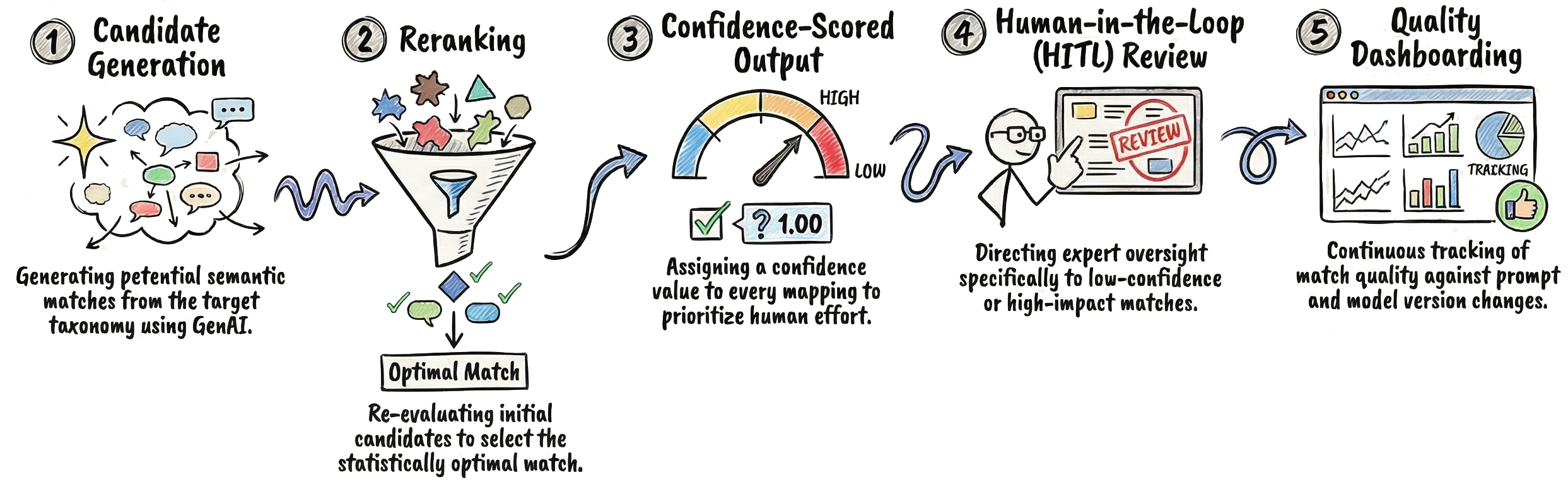
To ensure enterprise-grade reliability and solve the Banking client’s bottleneck, we engineered a comprehensive GenAI Classifier with core differentiators:
1. Two-Stage Verification to prevent hallucinations—first generate candidate semantic matches, then re-check and rerank them. Precision was ensured through a Two-Stage Mapping loop that prioritized domain-specific acronym hints, rich definitions, and historical mapping examples.
2. Measurable quality levers—AI adjustments shouldn’t be subjective, so we built a Quality Assessment Framework and dashboard to track match rates and confidence scores against every prompt and version change.
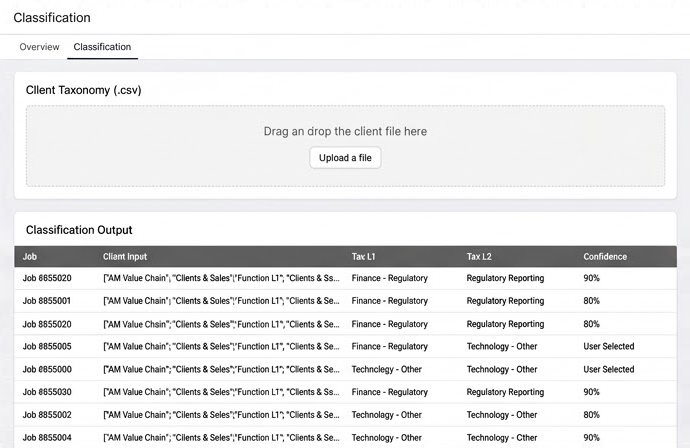
3. Human-in-the-Loop steering—we introduced a “Controller-in-the-Loop” model that shifts analysts from manual labor to strategic control, reviewing low-confidence items and handling edge cases by injecting Historical Mapping Examples and operational constraints without needing to write code.
Business Outcomes // Quantifying the Impact of AI Integration
The initiative enabled unprecedented scaling. Accuracy improved to 90% on existing datasets. On new and cold-start lists, accuracy reached 60%. Cycle time fell from 2 weeks to 3 days, delivering a 65% reduction. Manual effort reduction potential was 50%.
New capabilities include taxonomy-agnostic scaling and throughput expansion from 3–4 to 10+ concurrent client scenarios. Research timelines were reduced from 12+ months to 3–4 months. A quality dashboard ensures all system updates are proven and regression-free.
Takeaways // Lessons from Applying AI in the Wild
- Performance Insight: GenAI success depends heavily on structured inputs (domain-specific definitions and historical data) and repeatable workflow design, rather than just raw model power or prompt-engineering. A multi-model approach offers greater resilience.
- Collaboration & Control: The implementation established a Human-AI Collaboration Model, positioning human experts as strategic controllers of the AI system.
- Organizational Shift: The initiative transformed the organization’s perception of AI from a risky experiment to a systematic, research-based model—proving that AI can deliver significant, quality-preserving efficiency gains.